
Beyond the Resume: Education Abroad for Career-readiness and Life
/
Preparing for a 21st-century career isn’t a linear process
Is International Education Worth It?
Every education abroad student that I’ve advised over the years has asked some version of the same question: Will this experience be worth it? It is a fair question. A program abroad potentially can cost a lot of money, distract from graduation requirements, or pose a trade-off against internships, campus jobs, or other life commitments. Students and families (and more indirectly faculty, staff, and university administrators) want evidence—not anecdotes—that their investment will pay off in an increasingly competitive job market.
That research evidence exists. It consistently shows that students who study abroad enter the workforce faster, earn more, and develop the precise skills that twenty-first century employers demand. The more interesting—and honest—story, however, is how students best develop those skills. The career advantages of education abroad are real, but they are a byproduct of more profound growth: the formation of graduates who are resilient, self-aware, and genuinely capable of navigating the unfamiliar. In a world defined by technological disruption and cultural complexity, these traits are among the most durable professional assets that students, employees, and citizens may possess.
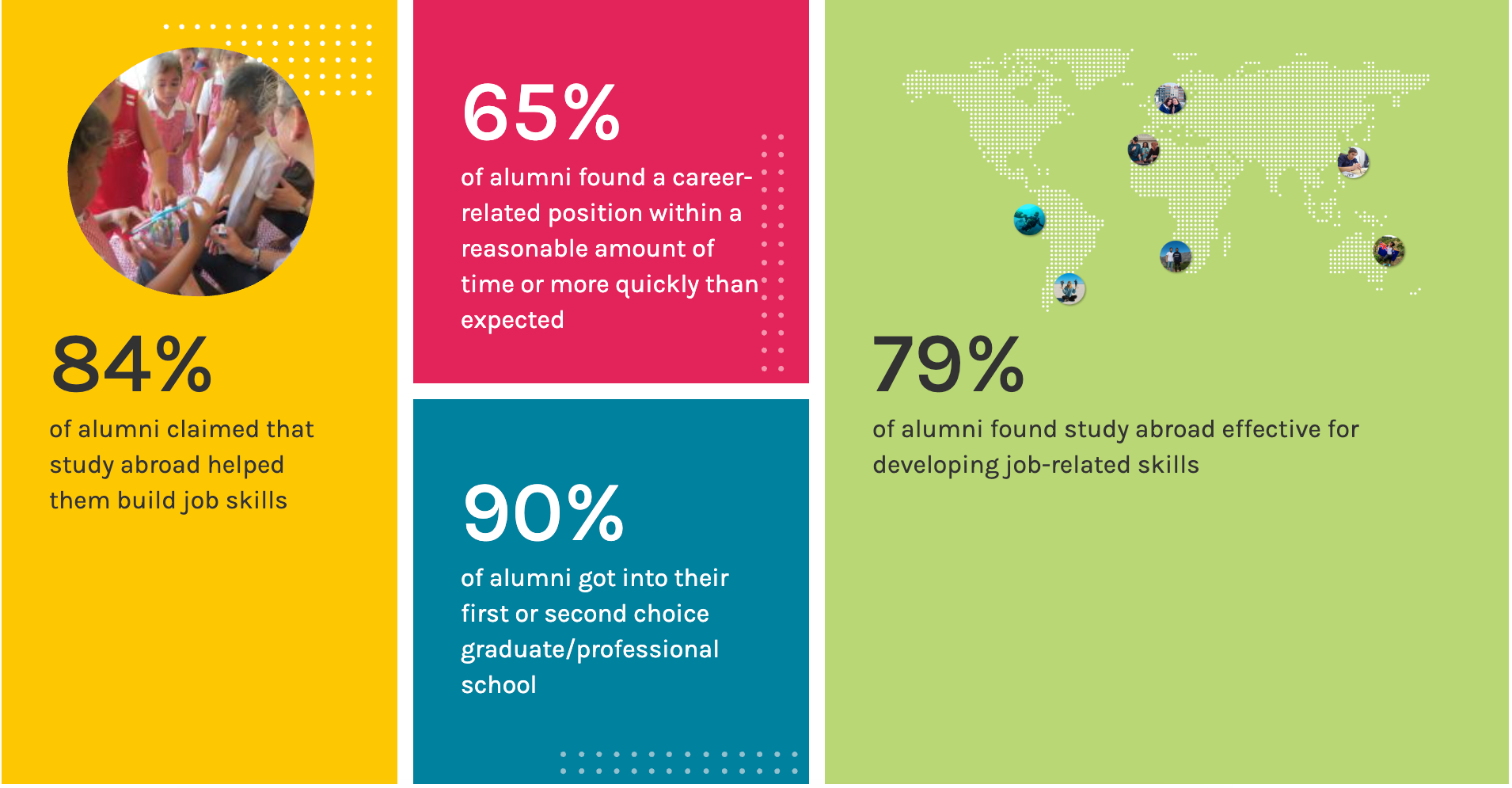
IES Abroad recent graduate survey results
Career Outcomes Are Real and Measurable
IES Abroad's longitudinal career outcomes study —one of the most cited in the field— found that 97% of more than 1,200 surveyed IES Abroad alumni between 2009 and 2011 had secured full-time employment within a year of graduation. During that same period only 49% of the general graduate population could say the same, according to a parallel Rutgers University study. IES Abroad alumni also earned, on average, $7,000 more in starting salaries than their non-study-abroad peers—a gap that held and grew in follow-up studies conducted through 2015.
The demand side of the equation is equally clear. A 2020 QS Global Employer Survey of 13,000 hiring managers and CEOs found that 25% of responding employers cited international experience as a recruitment priority, and 72% agreed that a second language increases candidate's appeal. Employers are not simply being polite when they say they value global experience; for a significant portion of them, it is a genuine differentiator at the point of hire.
The Institute of International Education's landmark report Gaining an Employment Edge: The Impact of Study Abroad on 21st Century Skills & Career Prospects (Farrugia & Sanger, 2017) provides perhaps the most rigorous national evidence to date. Drawing on a survey of more than 4,500 alumni of U.S. colleges and universities who studied abroad between 1999 and 2017, the report found that study abroad has a beneficial impact on 11 out of 15 "21st century workplace skills." The top five gains—intercultural skills, curiosity, flexibility and adaptability, confidence, and self-awareness—were reported by more than 70% of respondents. More than 50% also noted significant improvements in interpersonal and problem-solving skills.
These advantages are not limited to semester-long or year-long programs. A 2023 study highlighted by NAFSA found that 89% of short-term study abroad participants reported that their program actively supported the development of 21st-century job skills relevant to their professional and academic journeys.
Of course, many of these studies rely on alumni self-reporting and draw from populations that may already be motivated and resourceful. That said, the consistency of findings across institutions, program types, and decades of research is difficult to dismiss.
What the Data Actually Measure—and What They Miss
The skills that show up most consistently in these studies—intercultural competence, adaptability, curiosity, self-awareness, resilience—are not job-specific competencies. They cannot be taught in a single course or acquired through a credential. They are human capacities: the kind developed when a person is genuinely disoriented, must rely on unfamiliar resources, and experiences a greater sense of autonomy.
The World Economic Forum's Future of Jobs Report identifies analytical thinking, creative thinking, and self-efficacy—defined as resilience, flexibility, and agility—as the three most critical employee skills. None of these are technical skills. They are qualities of character. They describe not what a person knows, but how a person acts when the world does not cooperate with their expectations.
Framing these as "career skills" is accurate but incomplete. Adaptability is not only valuable in a job interview. Intercultural empathy is not only useful in a global business meeting. Self-awareness is not only an asset on a performance review. These capacities are the substance of a full human life—the tools by which people form meaningful relationships, participate in democratic society, and weather the losses and reinventions that every life will eventually demand. What these career data are really tracking is the formation of people who have learned, in a deep and embodied way, that the world is larger than they thought—and that they are more capable than they knew.
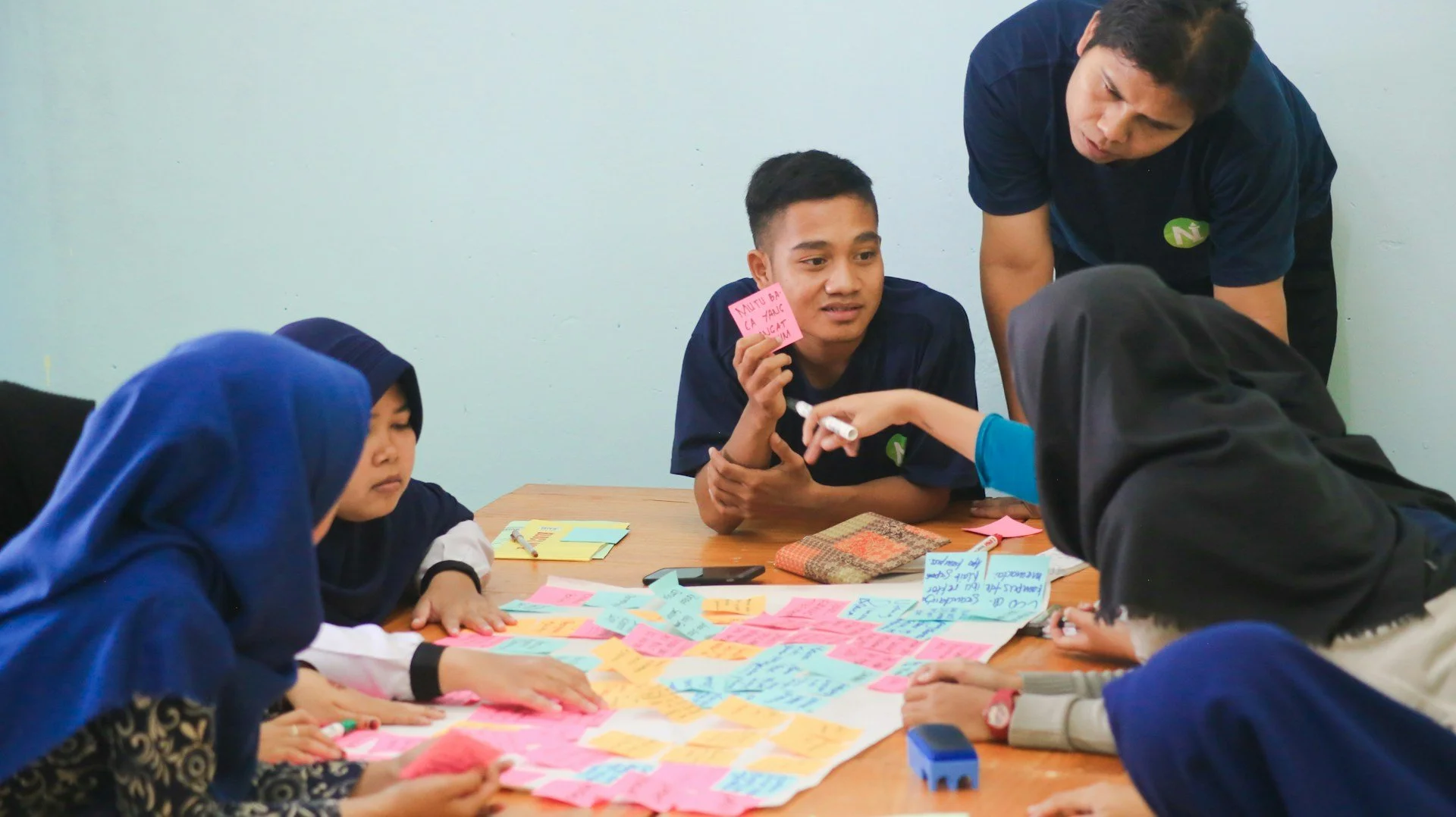
Career skills are life skills
Integrative Learning and Self-Authorship
Qualitative research reaches the same conclusion from a different angle. Frontiers: The Interdisciplinary Journal of Study Abroad, one of the field's leading peer-reviewed publications, has documented these developmental outcomes across decades of scholarship. Work by Stebleton and colleagues (2016) frames education abroad as a "high-impact practice"—in the same category as undergraduate research, service learning, and capstone experiences—precisely because it fosters integrative learning: the kind that connects intellectual content to personal identity and civic life.
The Forum on Education Abroad situates this dynamic within a broader framework of self-authorship—the developmental process by which students move from simply absorbing the expectations of others to constructing their own values, relationships, and sense of purpose. Education abroad, when well-designed, is one of the most reliable catalysts of that process in the undergraduate experience.
Self-authorship matters enormously for workforce readiness but, of course, on a longer timeline than achieving one’s first job. The graduate who has undergone genuine disorientation abroad, who has had to ask for help in an unfamiliar language, who has revised their assumptions about what is normal and natural and correct, is not simply employable. They are adaptable. In a labor market experiencing unprecedented convulsions from artificial intelligence, automation, and geopolitical volatility, adaptability is the quality that will determine not just the first job, but all positions in perpetuity.
The Access Problem
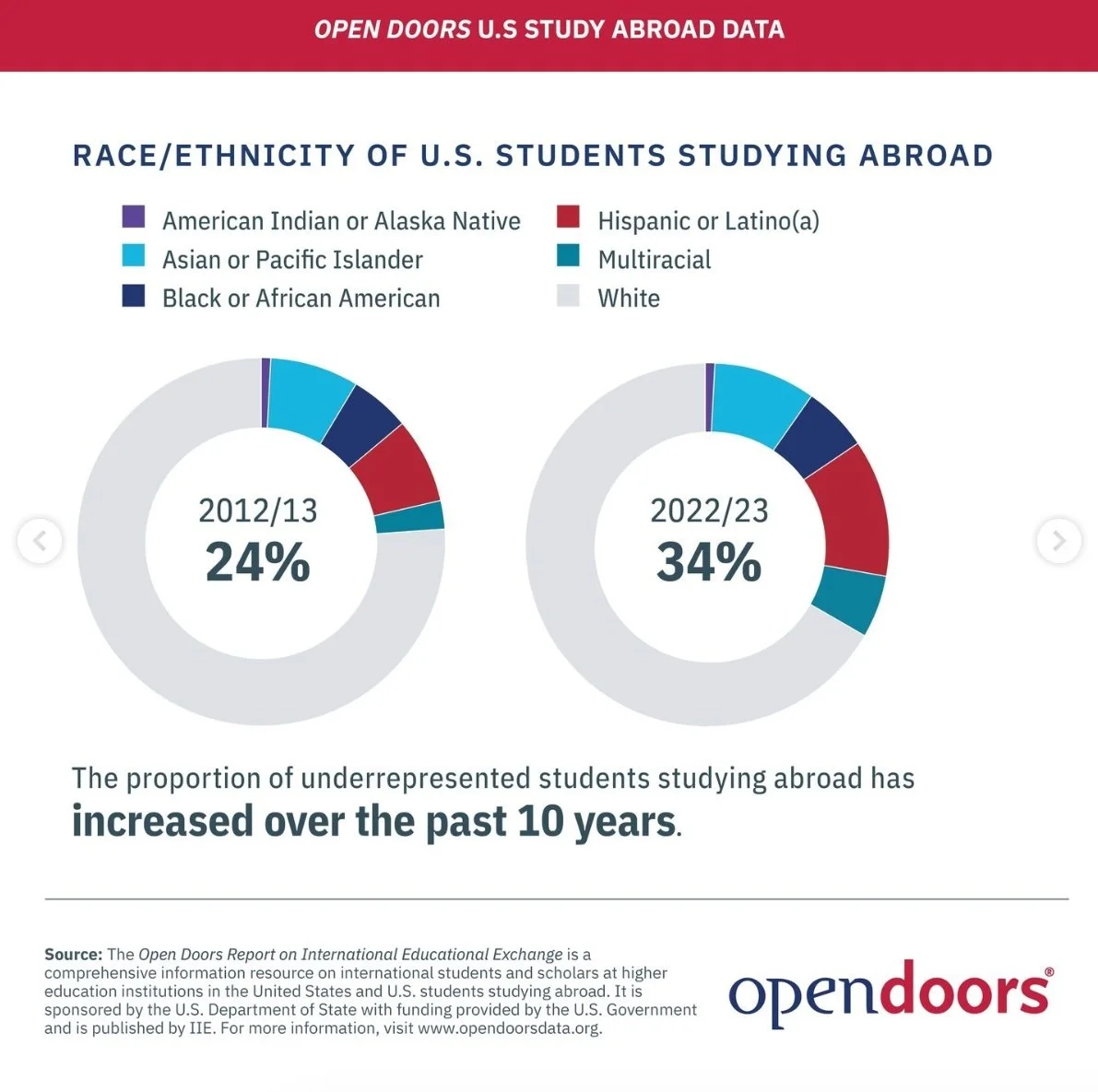
Any honest treatment of education abroad must reckon with who gets to participate. Despite decades of documented benefits, NAFSA reports that only about 1% of all U.S. college students currently study abroad, with minority students remaining gravely underrepresented. If education abroad builds both career advantage and those personal capacities that constitute a flourishing human life, then its concentration among already-advantaged students is a foundational equity problem.
Institutions and policymakers that genuinely believe in education abroad's value have a responsibility to treat access as a structural priority. Scholarship programs, affordable short-term options, and proactive advising for first-generation and underrepresented students help ensure that education abroad's promises become available to everyone.
What Well-Designed Programs Do Differently
For faculty and staff designing programs, the research offers a clear practical message: intentional structure matters more than duration.
As one practitioner quoted in NAFSA's IE Magazine put it: "Employers value the international experience, but they don't necessarily know how to value it." That gap—between what students gain and what they can articulate—is where program design makes its biggest difference. Pre-departure orientation, structured in-country reflection, and post-experience advising that explicitly connects outcomes to transferable skills are what turn an adventure into an education—and an education into a career advantage.
IIE's research confirms that the career impact of study abroad varies significantly according to program characteristics, study destinations, and students' stated goals. A program built around intentional intercultural learning outcomes will reliably outperform one built around logistics alone.

Intentional design is itself a foundational life skill—whether for a career or trip
Conclusion
Students, parents, and advisors are right to ask for evidence. Students who study abroad enter the workforce faster, earn more, and develop the skills that employers across sectors say they most urgently need.
The deeper case for education abroad, though, does not rest solely on salary data. It rests on what it means to educate a person for a century in which the only certainty is change—in technology, in culture, in the global distribution of economic and political power. The student who has learned to be productively lost, who has had to rebuild their social world from scratch, who has discovered that their assumptions about how things work were revisable—that student is not just ready for a job. They are ready for a life.
The goal of education abroad was never only to produce a stronger resume. It was to produce a more capable human being. In this century, those two things are closer together than they have ever been.
